Overview
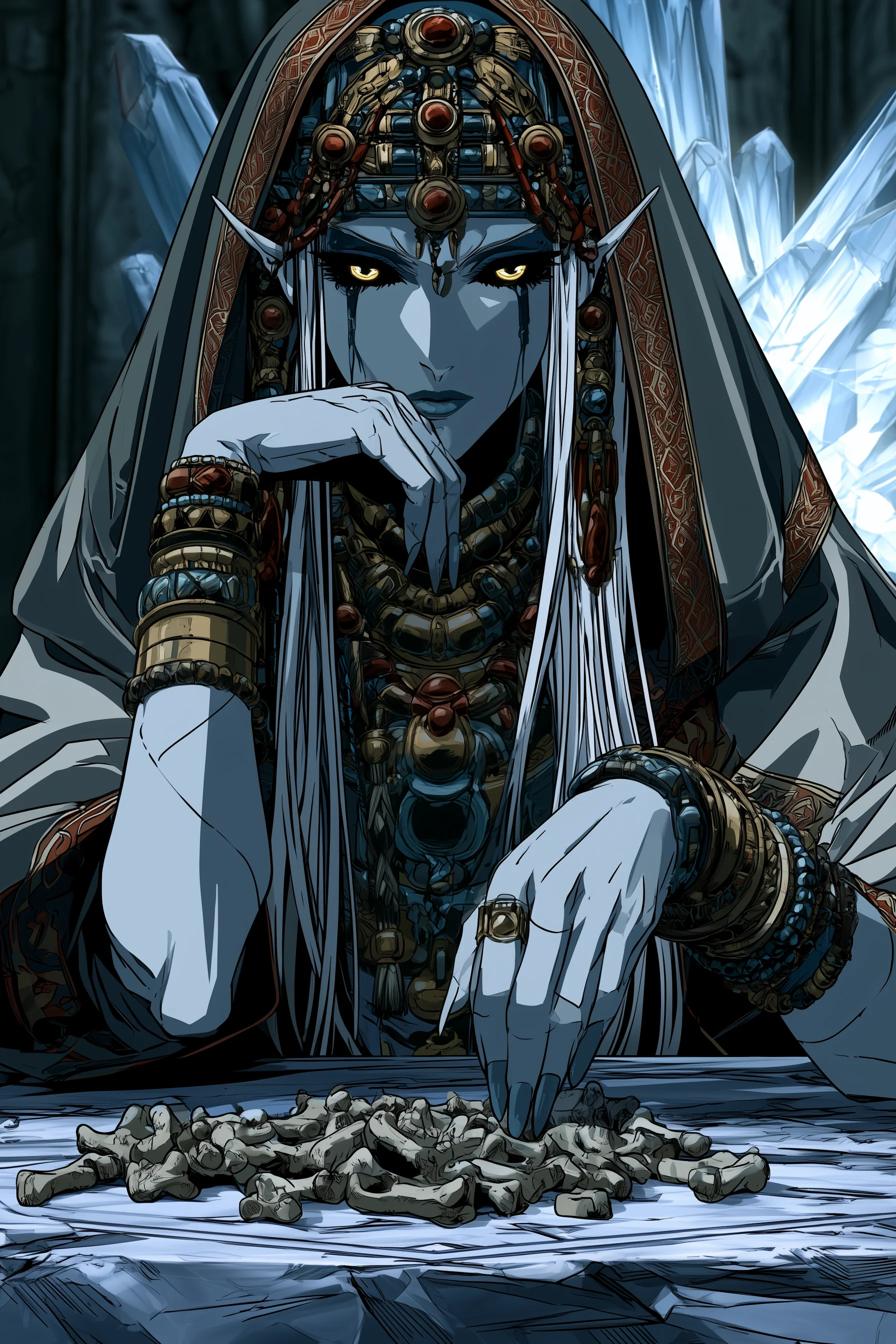
Uttaragiri does not adapt. That is the point of it. Behind walls of enchanted ice, inside a lattice of aligned crystal that catches magic and will not let it go, the north keeps what the rest of Mundu is losing. Spells hold here. Enchantments outlive their makers. Lowlanders who make the climb describe the same thing within an hour of arriving: a charged quality in the air, a pressure behind the eyes. The Ísvaktar do not describe it at all. It is simply what home feels like, and everything they do is in service of keeping it that way.
The Ísvaktar have held these heights since before recorded history, and somewhere in that history they turned isolation into doctrine. Every station of their society serves the same work: conservation against the decline. In the ice-fortress libraries of the Crystallis Memoria, crystal-bound texts older than every living kingdom preserve warnings about cyclical depletion, and instructions (fragmentary, contested, obeyed anyway) for weathering such periods. The north read its own archive and believed it. Most of what looks like coldness to outsiders is that belief, worn daily. Ancient pacts bind the last ice dragons to Ísvaktar society as protectors and, rarely, as messengers.
Four stations organise every Ísvaktar community: Preservers, who maintain the archives; Defenders, who guard the passes; Cultivators, who feed everyone; and the rare Emissaries permitted contact with outsiders. Entry to the heights is controlled absolutely. Those who test this learn that the Frost Wraith Corps was not named for effect.
Geography & Climate
Uttaragiri occupies the northernmost reaches of Mundu, peaks so high the air thins to a hostile whisper; the highest inhabited plateau sits at 12,800 feet. The terrain is shaped as much by ice magic as by geology. Whole cliff faces are veined with glowing crystal, and certain valleys channel the wind through resonant stone into long musical notes that carry for miles.
The climate is brutal and the Ísvaktar have made it a servant. Temperatures rarely clear freezing even in the brief summer; blizzards build in minutes; fog banks roll in from the northeast each winter and erase whole approaches. The cold preserves food, preserves archives, and kills the unprepared, in roughly that order of local concern.
Within the crystal network maintained by Hrimtindur's Preservers, spells function reliably, magical items keep their potency, and the decline that governs the rest of the continent simply does not apply. This preserved concentration is the Ísvaktar's greatest treasure and most jealously guarded secret, and every rule in the north follows from it.
Settlements
Hrimtindur — The Preservation Capital
The jewel of Uttaragiri perches atop the highest accessible plateau, its crystalline architecture radiating outward in seven perfect concentric rings — governance at the centre, then research, education, crafting, sustenance, defence, and observation. At its heart rises the Kylmspire, an intricate ice-crystal formation that spirals skyward like frozen breath, housing the sacred Iskvardhall where Preservers maintain ritual cycles performed in unbroken sequence since the Age of Awakening.
The Hrimthek-Minne (Frost Memory) is Hrimtindur's most prized institution — the most extensive repository of magical knowledge in Mundu, where crystal-bound texts dating back millennia rest in absolute stasis. Access follows rigid hierarchical protocols, with certain chambers allegedly containing knowledge from before the world's sundering. Outsiders are never permitted inside.
Iskfjendar — The Iron Gate
Commanding the primary southern approach to the Uttaragiri heights, Iskfjendar rises from a narrow mountain pass in three concentric tiers. Each is encircled by walls of magically distinct ice: the outermost disperses kinetic energy, the middle absorbs and neutralizes hostile magic, while the innermost responds to unauthorized entry with deadly crystalline growth. Here the feared Isøkelse (the Frost Wraiths) are trained and garrisoned, watching every outsider who approaches with unwavering patience.
Luminaris Archive
Set within a valley protected by surrounding peaks, the Luminaris Archive serves as the primary repository for pre-Catastrophe knowledge. Of the small number of non-Ísvaktar permitted residency here, most are approved researchers who have signed binding magical compacts restricting what they can copy, share, or remember after departure. The Archive's existence is publicly known; its contents are not.
The oldest open record in the north needs no interpretation, which may be why approved researchers are allowed to see it. In the year 531 the second moon went out. The crystal page notes the night, the sky before, and the sky after, and explains nothing. Lowland astronomy has considered the question settled for centuries. Scholars who reopen it report the same experience: the sources are thinner than they expected.
The Wars the Mountains Remember
The north's wars are old, and the north wins them slowly. When Dhruva VIII, last king of the plains, brought his dragon-war into the Uttaragiri, it cost the mountains dearly: the sagas count more than a hundred dragons dead across thirty years. It cost the king more. The war's final winter is remembered as the Red Thaw, when the ice dragons melted a glacier field beneath his northern army and froze it again. The sagas cite that winter when they say the mountains choose their own kings. Fewer than twenty dragons remain. The north has not forgotten who spent the rest, or on what.
In 612 the miners of a southern house breached an Ísvaktar boundary marker in the Shieldpeaks. Frost Wraith Commander Tuhinadrishti Karaka did not give battle; she sealed the passes with ice and let the mountain do the killing. Forty-three miners died. Their own ruling house denied them burial. The exiled House Andharakhanij has carved their names into the skin of every child born to it since, and the Ísvaktar, who keep exact records, have never once disputed the count.
Twice the north has bent, and both times on its own terms. The Siege of Frostreach lasted thirty years: the Azduar could not beat Frost Wraiths in the open, so their general set a four-hundred-pound hammer to mathematically timed work against the bedrock until the mountain itself was negotiating. The Thaw Accords that followed opened limited archive access, and House Sheetavira broke with the Grand Preserver over them, the first crack in Ísvaktar unity since the passes closed. Centuries later, when a coalition of the plains demanded the northern nexus for its Renewal Doctrine, the Dominion simply refused, and the war ended without a battle: the coalition's own array-masters read the smuggled ice-archive warnings and resigned. The north counts that as its cleanest victory, the one it won by being read.
Culture & Society
The Ísvaktar believe they are custodians of a wisdom that will seed renewal when the age of decline finally ends. The belief makes their hierarchies sacred rather than merely tolerable. The Iskvurdering, the assessment of magical sensitivity administered at five years old, irreversibly fixes a child's station; families accept it with quiet resignation, because to question the system is to question the mission, and the mission is what the north is for.
Ísvaktar garments layer magically treated fabrics in silver, white, and ice blue; metallic thread identifies community, and formal embroidery encodes lineage in draconic and snowflake geometry. The people themselves carry the mountains in their bodies: pale blue-white skin, hair that crystallises in extreme cold, a third eyelid against the glare.
Relations with outsiders are minimal by design. Tabaxi caravans trade lowland goods for crystalline work at the margins, and most Ísvaktar go decades without meeting anyone else. In recent years, dissidents have fled the heights carrying tales of what lies sealed in the deepest ice caverns. The Frost Wraiths recover most of them. The tales circulate anyway.
Flora & Fauna
Crystalline Lichen
Blue-white growth that absorbs minerals from rock faces, creating formations resembling ice crystals. Ísvaktar healers harvest this lichen to create potent medicines that prevent frostbite and treat cold-related ailments. As magic fades, its natural antifreeze properties have intensified to compensate.
Singing Frost Pine
Coniferous trees whose needles vibrate in the wind, creating haunting melodies. Once a magical characteristic, these trees now produce specialized resonant needles to achieve the same effect through purely physical means. Their sounds warn of approaching storms and attract pollinators adapted to cold environments.
Whispering Moss
Found in mountain caves, this moss absorbs ambient sound and replays it faintly, attracting curious animals. Azduar miners listen for its whispers to detect instabilities in cave structures — a practice learned through bitter experience with unexpected collapses.
Snow Hares
Small mammals whose fur changes colour seasonally for camouflage. They have developed thicker coats and more efficient metabolism as temperatures have become more extreme with magical decline. Population fluctuations serve as indicators of broader ecosystem health.
Memory Ravens
Intelligent birds with remarkable problem-solving abilities who collect and study objects that once held magic. Ísvaktar communities have developed cooperative relationships with these ravens, who help locate lost travelers in exchange for food and shelter. Their apparent purposefulness with magical artefacts unsettles even the most sceptical scholars.
Frost Beetles
Insects with crystalline shells that refract light in patterns once used to store information. Older specimens preserve light refraction properties that reflect magic levels from decades past, making them valuable to researchers tracking the decline. Their shells are prized by collectors across Mundu.
Frost Trolls
Regional troll variant whose legendary regenerative abilities have slowed with declining magic. They have developed cultural practices around wound prevention rather than healing, and now create intricate protective armours from ice and stone. Their society has grown more contemplative as their biological gifts fade.
Ice Dragons
Fewer than twenty remain — each older than the Catastrophe itself. The Ísvaktar's relationship with these ancient creatures is bound by pacts whose terms are never disclosed to outsiders. They serve as protectors and, occasionally, messengers. A single ice dragon can freeze a river crossing solid or shatter fortifications through thermal shock. They are individuals, not tools.
The Eldest of the Mother's Children
Uttaragiri keeps a god, and feeds it.
The Ísvaktar call him the Ice-Father in ordinary speech and the Eldest of the Mother's Children in the liturgy. He is the last of the great ice drakes, and he has held the high glacier since before the Ísvaktar had a word for themselves. His true name is a hoard-secret. Those who have heard it do not come back down to repeat it.
The old teaching holds that all things were born of the mother, and that dragons were her first children, woven before the mountains, drinking straight from her veins. Whatever the truth of it, the Eldest remembers a world no living scholar can describe. He was old when the ice came. He was old when the Catastrophe took the magic out of everything, and unlike almost everything else that drew breath in that year, he did not die of it.
He is not a symbol and he is not a legend. He is a fact on a mountain, and every institution in Uttaragiri exists in some relation to him. The shaman college trains and ranks the region's casters; the hierarchy governs; both do so with one eye on the glacier. Foreign visitors sometimes ask whether the Ísvaktar fear him. It is the wrong question, and asking it marks the asker as a stranger. He is not feared. He is kept, the way a household keeps a hearth, and for the same reason: everything else in the house is arranged around the thing that must not go out.
The Tenth Winter
Once a decade, the finest caster of the generation walks up the glacier road and does not come down.
The offering is called the Tenth Winter, and it is the highest honour Ísvaktar society can confer. There is no coercion in it and no shortage of candidates. The shaman college selects a cohort; the cohort spends the decade at the hoard in study; and at the end of it the Eldest chooses which one he will take. To be chosen is to be judged the best of an entire generation by something that has seen fifty of them.
What the cohort receives in exchange is the reason Uttaragiri produces the most accomplished casters on Mundu. The Eldest teaches. Spells that died out everywhere else on the continent survive in his memory and are dictated, over years, to the students who climb up to him. Combined with the frozen ley the Uttaragiri crystals hold, it makes the high glacier the last place on Mundu where magical knowledge still increases rather than decays.
The doctrine holds that the offered are not lost. They persist within the Eldest, carried, remembered, part of him. He says so himself, and no one has ever found a way to check. Families of past offerings speak of them in the present tense, and would find the question of proof both crude and beside the point.
The college keeps the calendars. There have been disputes about the reckoning in recent generations. The college has settled all of them.
The Eldest is the last living dragon in the north, but he is not the only one in Uttaragiri.
Wyrmbound shamans carry the spirits of dragons who have died, bound not by study but by being chosen, which cannot be arranged for or trained into anyone. The college sends seekers the length of the continent looking for them, and any wyrmbound who comes to Uttaragiri is received as an honoured guest for as long as they care to stay. Most stay. The arrangement is not explained to outsiders, and the Ísvaktar are visibly uncomfortable when pressed on it.
What the glacier receives from these visits is the only company left of its own kind: dead kin, speaking through borrowed mouths.
Threats & Dangers
The most immediate danger in Uttaragiri is the Ísvaktar themselves. Unauthorized entry into their territory is not merely unwelcome — it is potentially fatal. The Frost Wraiths patrol approaches with crystal-resonance targeting systems that identify threats by heat signature and movement pattern. First-time intruders receive a warning. Second-time intruders are recovered, if they're fortunate, by the settlement they departed from.
For those with legitimate business in the region, the terrain itself poses constant challenge. Blizzards materialize without warning, navigation landmarks are unreliable in whiteout conditions, and certain passes are defended by crystal-powered sentinel automata that cannot distinguish between hostile forces and confused travelers. Altitude sickness affects most lowland visitors within hours of ascending to inhabited elevations.
The deeper mystery of Uttaragiri concerns what the Ísvaktar are hiding. Dissidents who have escaped the region speak of sealed sections of the Crystallis Memoria containing knowledge of the world's fate — information the leadership has deemed too dangerous or too destabilizing for their own people, let alone outsiders. What they know, and why they suppress it, remains one of the great unanswered questions of Mundu.
At the Table
For the table: a trade party bound for the Iskfjendar gate has lost its licensed guide to the altitude, and without one the first warning arrow becomes the second. A half-frozen dissident in a snow-cave clutches a crystal she will not surrender, and asks (with Frost Wraiths tracking magical resonance across whole valleys) to be taken anywhere south. And a Luminaris Archive under-keeper offered, once, in writing he then burned, to let the right visitors see what the Ísvaktar sealed.
Gallery