Overview
The Marusthali is a desert that remembers what was done to it. Northern chronicles call the scarred interior the Defiled Lands. The people who live beside it use a shorter word: Kalizam, the black ground. They say it the way you name a debt that outlived the debtor. The blackened soil, the sand gone to crystal, the springs that poison the mouths that trust them, the dust storms that leave the unprotected shaking and word-blind: all of it is the work of the Jadukhor, the magic-eaters, who drained the land into their own long lives until the land gave out. It has not recovered. The old women say it is not trying to.
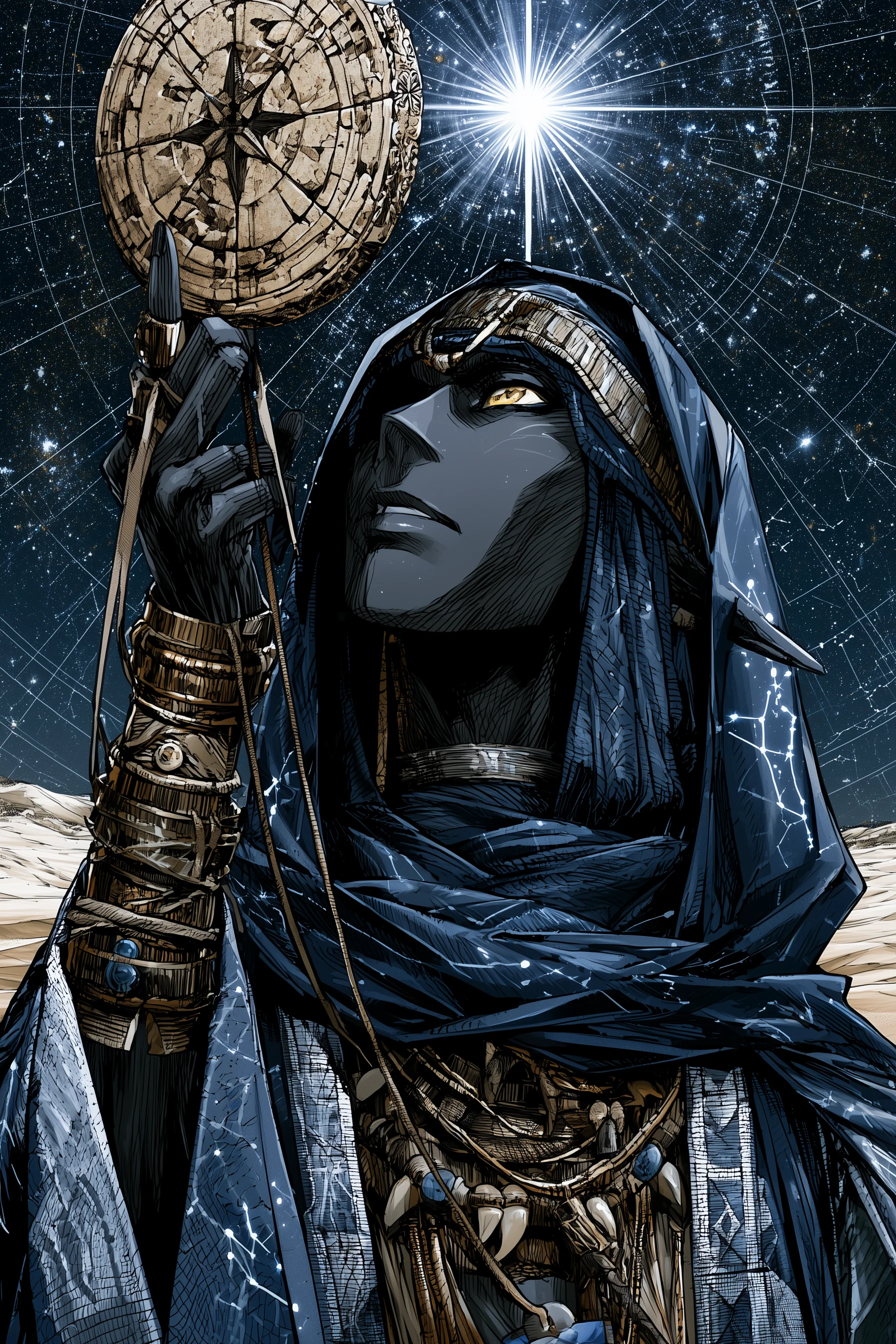
People survive here anyway. The Dun'elfata, dark elves whose bronze skin and narrow eyes reflect millennia of desert adaptation, navigate the corruption through celestial observation, water discipline, and memory songs that encode generations of survival knowledge. The Tabaxi nomads, organised into specialised family clans, maintain mental maps of the desert's shifting dangers that no outsider's charts can match. Scattered human settlements cluster around the three remaining functional springs of the Sab'atu Yanabi', the Seven Springs, of which only three still flow — all controlled by Sultan Amir Zhul of Jowhar Al'atash, a man of mortal years and terrible ambitions whose control of water makes him the most consequential person in the desert regardless.
There is no unified authority in the Marusthali. Each settlement, each nomadic clan, each caravan confederation operates as an independent political unit connected to others only by commerce, treaty, necessity, or hostility. This fragmentation has historically made the region unconquerable by conventional means — there is no capital to capture, no government to topple, no unified resistance to defeat in a single decisive engagement. The desert does not yield to armies. It absorbs them.
Geography & Climate
The Marusthali's surface presents three distinct zones to those with the knowledge to read them. The outer reaches, nearest the borders with Haritkshetra and Pittalpradesha, are harsh but navigable desert — inhospitable enough to deter the casual traveler, but survivable for those with preparation and knowledge. The middle reaches are where the old sorcerous damage begins to manifest: crystallised sand formations of unnatural geometry, soil that corrodes metal within days of contact, dust storms that carry toxic compounds causing neurological effects in the unprotected. The deep desert, the interior, is a place that even the most experienced desert guides navigate around rather than through, except when the specific seasonal and astronomical alignments that the nomads track make brief transit possible.
The Hidden Tunnels beneath the desert, which the Tabaxi call Uruq Alsahra', the Desert's Veins, are natural channels where magic flows beneath the surface. The Dun'elfata publicly dismiss such claims while simultaneously controlling access to these passages, which connect settlements, allow unseen movement of goods and people, and in their deepest reaches descend toward something vast. Sand wurms patrol the deeper tunnels: massive burrowing predators whose territorial instincts make deep exploration suicidal.
The Seven Springs, Sab'atu Yanabi', were once the lifeblood of the region. Three still function. The Fourth dried around 2,100 AC, killing the settlement of Maa'ulakhir over a forty-year death as Zhul raised water prices for external supply. The Fifth was poisoned by the accumulated sorcerous corruption around 3,400 AC — the water began glowing first, then mutated livestock, then killed. The Sixth was deliberately destroyed during the Jadukhor Wars, one Jadukhor collapsing an aquifer to deny it to a rival. The Tabaxi still navigate a forty-mile mourning detour around its dead location.
Settlements
Jowhar Al'atash — The Thirsty Jewel
Jowhar Al'atash holds thirteen thousand people and all three of the desert's living springs, which is another way of saying it holds the desert. Its architecture states the order of things without a herald: obsidian towers at the wet centre, rings of housing drying outward, and at the rim, where the water arrives last and warm, the tents of the slave caste.
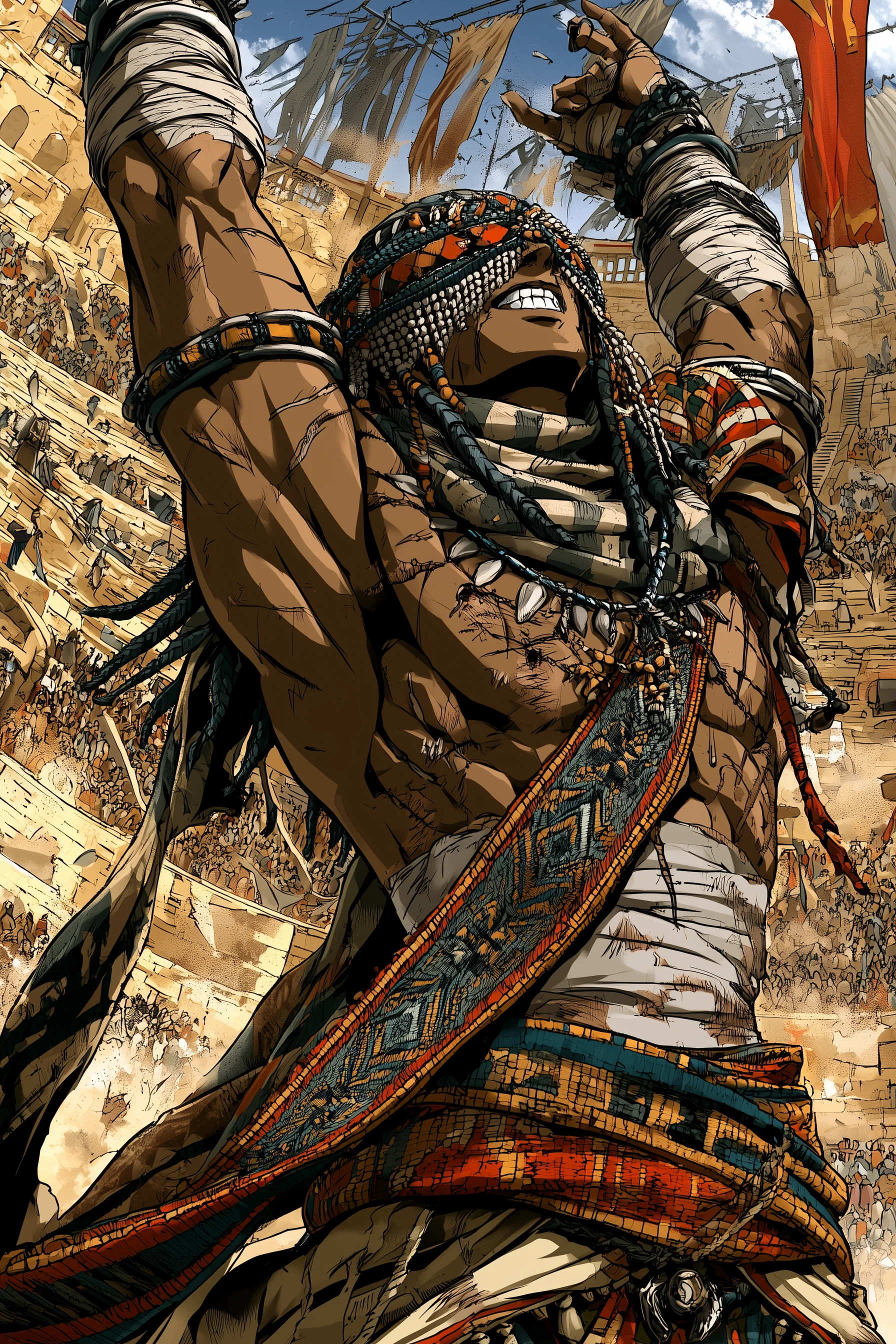
Sultan Amir Zhul is an old man, older than the desert usually allows, and he has spent most of those years afraid of dying. Slaves are brought up into the obsidian towers. Not all of them come back down. The city does not discuss the arithmetic. His Obsidian Champions, gladiatorial veterans equipped with rare salvaged weapons, enforce an order based on a simple principle: water access determines life. The Grand Arena at the city's centre offers the only path from slavery to citizenship for those with sufficient skill and luck. Most have neither.
Madinat Altahawul — The Shifting City
The legendary shifting city of the Tabaxi manifests and dissolves like a mirage, its location determined by astronomical calculations closely guarded by Tabaxi navigators who establish these temporary settlements at optimal magical convergence points. As the desert's original nomadic culture, the Tabaxi maintain authority over these gatherings through both traditional claim and practical necessity. The Dun'elfata attend with carefully negotiated delegations; humans serve as witnessed mediators between the two cultures during the ritual exchanges of each manifestation.
The Breakings
Not every desert war ended in a breaking. When the Renewal Coalition came for the southern nexus, the illusion-house of Mrgatrishna held the approach for fifty years with landscapes: phantom ranges, false rivers, whole settlements with smoke rising from imaginary chimneys, until the Coalition was fighting empty desert and knew it. The defence consumed the house's mirage-wall craft entirely, and General Mrgatrishna Bhramajaal died staring at the air where the last illusion had stood. The house survives. The craft does not.
The Plumaj Sky-Clans, two centuries harvested as prized slave-stock by the western sultanates, came back reunified under Khagesh Vayuvansha and broke two of the western sultanates outright in the Wing Wars. The desert remembers the sight in a dozen songs: grounded sky-people, who had learned ground-war the hard way, teaching it back.
Culture & Society
The Marusthali's defining cultural institution is the water ethic. To waste water is the gravest social transgression across virtually every culture in the region. To share water with a stranger is an act of profound trust, implying a depth of commitment that outsiders often misread as mere hospitality. Water ceremonies surround its discovery, collection, and distribution; those who can locate new sources command immense prestige; those who hoard water during shortage are remembered for generations.
The Dun'elfata carry their dead with them. Nomadic bands practice elaborate mummification rituals that transform deceased ancestors into magical reservoirs, carried as both spiritual guides and practical resources during ceremonies. Their speech is economical, conserving moisture and energy in every interaction, and carries double meanings that outsiders require years of immersion to begin to parse. "Stars guide the wise, mirages guide the fool" is a statement about navigation. It is also a statement about power.
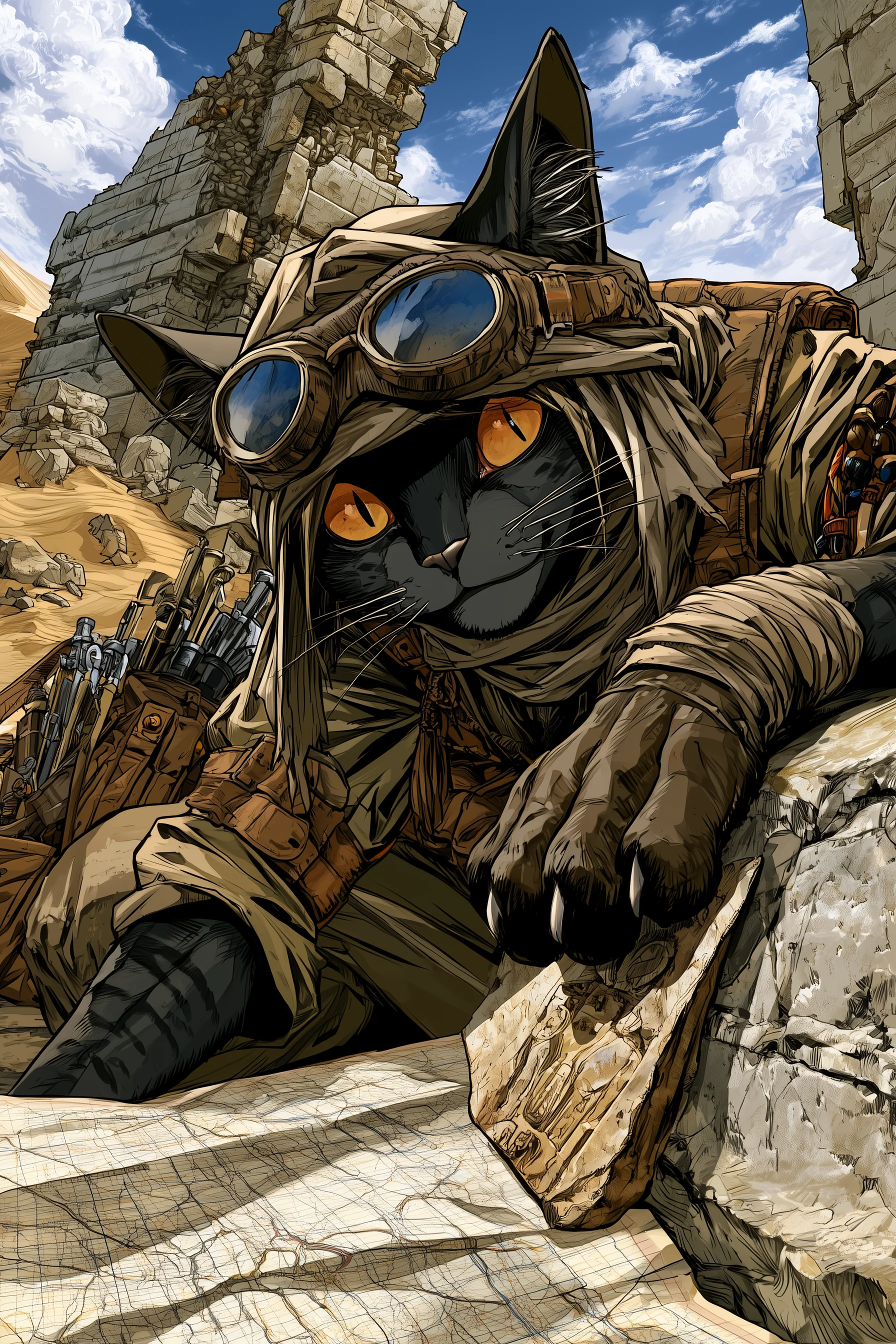
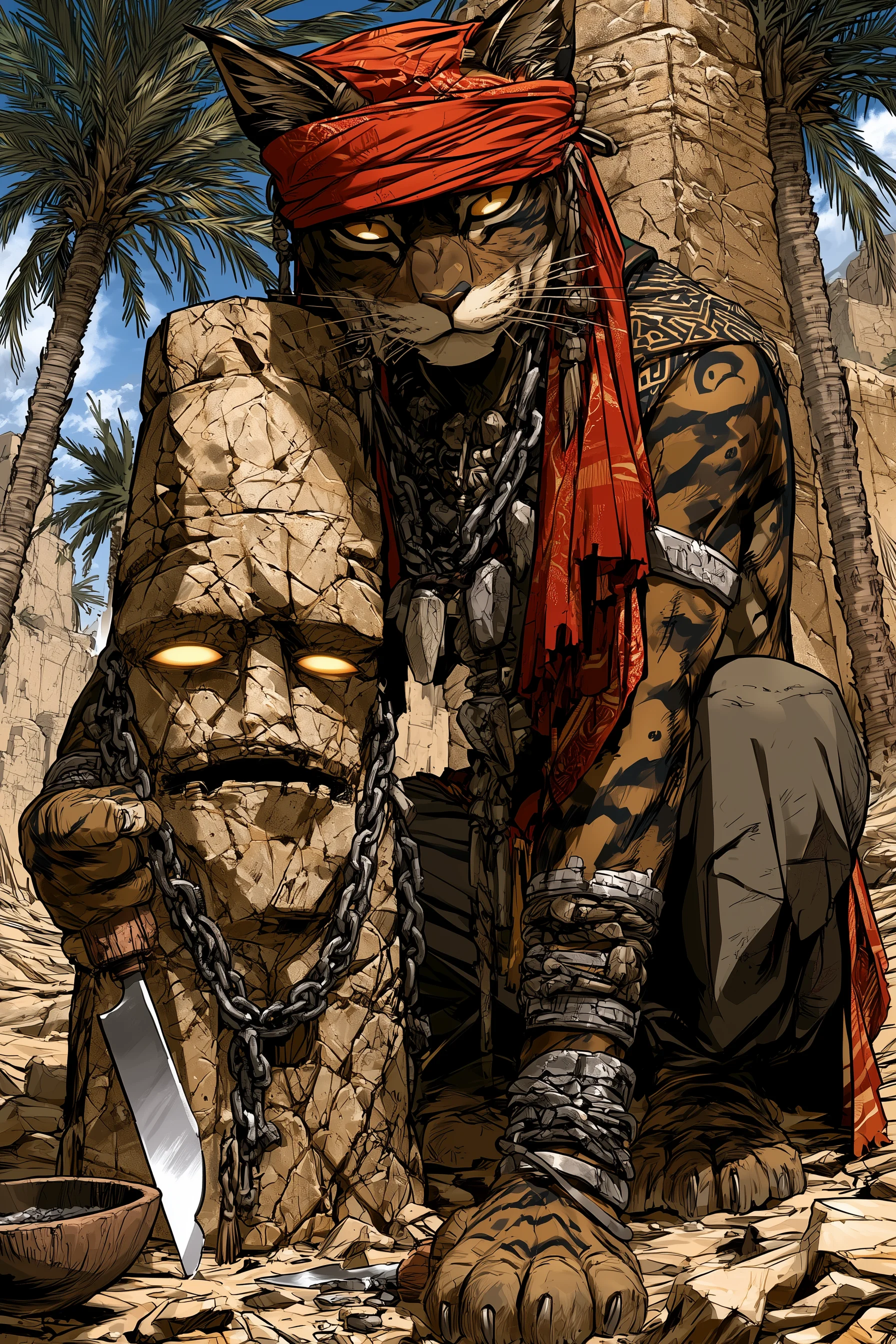
The Tabaxi organise into specialised clans: Sand Trackers who maintain mental maps of the desert's shifting dangers, Water Harvesters who extract moisture from seemingly barren environments, Moon Readers who trace connections between lunar phases and magical fluctuations, and Relic Hunters who locate and safely handle buried artifacts of the old world. Something else wakes as the old power fails. Every caravan has a story now: the child who covers her ears a full minute before the sand begins to move, the dealer who plays his tiles face-down because other hands whisper to him. Desert families used to hide such children. Now they walk them to the Mind Forges, where the gift is taught discipline, and come home paid. The coastal academies sent scholars to study the matter. The Mind Forges sent them back.
Flora & Fauna
Wandering Cacti
Mobile succulents that uproot and slowly move toward water sources. With declining magic they have developed specialized root structures for physical movement rather than magical locomotion, creating vast underground water-finding networks that experienced desert travelers track. They grow only where underground water exists within reach of their deep roots.
Mirage Bloom
Desert flowers whose petals create shimmering visual distortions through heat refraction rather than magic — mimicking water surfaces to attract pollinators. Dun'elfata use them to mark safe paths through the desert, as they grow only above underground water sources. A mirage bloom that appears in an unexpected location is significant navigational information.
Tombstone Palm
Rare trees that grow over the bones of creatures that died seeking water, incorporating minerals from the remains to create trunk patterns resembling the deceased. Tabaxi nomads consider these trees sacred markers and leave offerings at their bases. The oldest specimens mark deaths from before recorded history.
Dune Skimmers
Small reptiles with specialised scales allowing them to sail across sand surfaces. Desert travelers watch these creatures carefully — their movements indicate the safest paths through unstable dune systems that could swallow a caravan without warning. They have developed efficient water conservation systems as magical springs diminish.
Echo Scorpions
Arachnids with translucent exoskeletons allowing internal organs to be visible. They navigate by producing and sensing subtle vibrations through the sand. Their venom, once magically potent, has evolved into a complex chemical cocktail being studied by researchers. Large specimens command significant prices in markets outside the desert.
Sand Wurms
Massive burrowing predators of the deep desert and the tunnels beneath it. No two wurms share territory, the boundaries are enforced absolutely, and reading their markers takes years of desert schooling with harsh grading. Two things the old guides say only by daylight: the wurms still kill, but they no longer eat what they kill. And their own dead do not rot. There is a carcass in the outer reaches that hunters have walked past for nine years. The scavengers have not touched it. Neither has time.
Threats & Dangers
The harmonic substrate throughout the deep Marusthali is uniquely unstable — a consequence, most scholars agree, of the catastrophic magical overextraction practiced by the Jadukhor. The land was drained past its capacity to recover, and what remains is a substrate that has never fully healed. Magical equipment becomes a liability rather than an asset in the interior. Magical weapons misfire. Magical armour fails at critical moments. Magical logistics produces results ranging from unreliable to actively dangerous: portals, sending stones, divination, none of it to be trusted here. The nomads who have lived here for millennia have adapted to this reality. Outsiders who arrive expecting their magical advantages to function as normal do not always survive the correction.
The water wars are permanent. Every transaction, every alliance, every betrayal in the desert revolves around who controls water, who needs water, and who will die for water. Travelers who do not understand this dynamic before arriving will learn it quickly and unpleasantly. Water freely offered by strangers is a social contract with terms that must be understood before acceptance. Water refused when genuinely needed is an insult with consequences. Learn the terms before you drink.
The strange lights that dance across the deep desert at night, which the Dun'elfata attribute to the ancient ones stirring beneath the sands, are not safe to approach regardless of their apparent beauty. Those who have approached them have not, as a pattern, returned to describe the experience in detail. The Dun'elfata dismiss the lights as natural phenomena when outsiders ask. They also camp at least three miles away from them regardless of the navigational inconvenience this creates.
At the Table
For the table: a stranger's freely offered water has been accepted by someone in the caravan, and the terms arrive at the next oasis: a debt payable in escort duty across the deep desert. A merchant bound for Madinat Altahawul, the Shifting City, needs guards who understand that their enchanted gear is baggage here, not advantage. And the Dun'elfata band ahead has broken camp hours early, leaving a marker that means the lights are walking — three miles' distance is the advice, and tonight it may not be enough.
Gallery